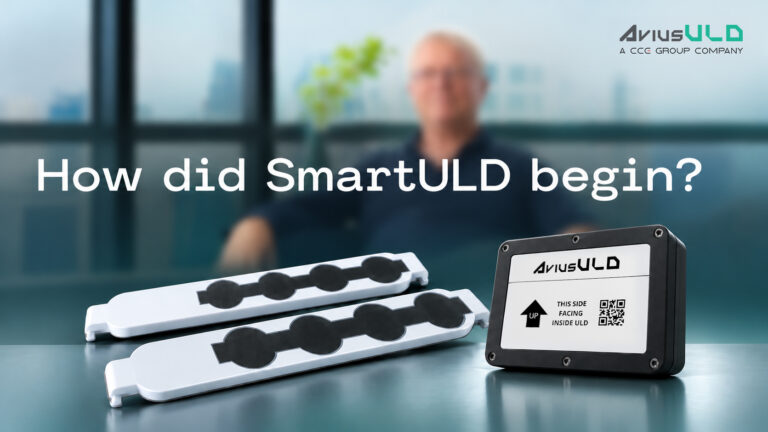
How did SmartULD begin?
It started with a conversation at the World Cargo Symposium in Hong Kong. We were discussing the limits of ULD tracking and the need to manage equipment better.
We wanted to know precisely where ULDs were without installing expensive tracking infrastructure at every location. So we began working with our technology partner eloc8 to develop a solution.
What were the limitations of the existing technology?
Traditional Bluetooth tracking depends on a reader being close enough to pick up the signal. You might know a ULD was last seen at an airport in London, but not which warehouse it is in, how long it has been there or whether it has moved.
Once the ULD moves beyond a reader, visibility disappears. You are back to calling people and asking them to find it. We wanted to take that guesswork out of the process.
How did you remove the need for tracking infrastructure?
We wanted tracking to work wherever the ULD went, including places where installing readers would never make financial sense.
Installing readers everywhere a ULD might go is not practical, especially at smaller airports or freight forwarders handling only a handful of ULDs.
SmartULD sends data through existing mobile networks, so it does not need dedicated readers at every location. The tracking travels with the ULD, including beyond the airport.
That lets the ULD report its own location without someone finding it, scanning it or entering an update manually. The next challenge was keeping the device powered.
Why is battery life such an important part of this?
Our competitors often quote three to five years of battery life for BLE trackers. In active use, with the reporting frequency needed to manage a working ULD fleet, that is usually closer to one to three years.
The more often a device reports, and the more sensors it supports, the faster the battery runs down. It is the same with your phone: the more you use it, the faster the battery drains.
We developed SmartULD with eloc8 to remove that limitation. SmartULD is the world’s first kinetically powered, infrastructure-free ULD tracking system. It captures energy from the normal movement and vibration of the ULD and uses that energy to recharge itself.
That means we do not have to trade useful data for battery life. SmartULD can provide frequent, precise location updates, support additional sensors and give operators a real-time view of their fleet without routine battery replacement.
What can SmartULD tell you beyond its location?
One of the most important things SmartULD can do is provide earlier warning of a lithium-ion battery fire. The Fire Tag detects gases batteries can release as they begin to fail, warning of possible thermal runaway, where a battery heats uncontrollably and can catch fire. That gives people more time to respond.
Precise positioning can also check whether a ULD has been loaded onto the correct aircraft and into its assigned position, helping flag a possible mistake before departure.
Our occupancy sensor shows whether a ULD is empty or occupied, helps estimate space use and can confirm that no cargo has been left behind after unloading. SmartULD automates checks that often depend on someone physically looking and recording the result.
What has happened since the rollout in 2025?
We’ve now delivered 30,000 SmartULD devices that are flying every day. They’ve reported from more than 600 airports across over 120 countries, as well as more than 7,000 locations outside airports.
We have also seen journeys that manual reporting completely missed, including ULDs in a different country from where the records said they were. That means decisions can be based on equipment that simply is not there.
In six months, the platform processed more than 100 million messages, giving us a much clearer picture of where equipment goes and how it is used.
How did you extend the technology to pallets and cabin safety?
Pallets often travel beyond airports and onto other forms of transport, making them even easier to lose track of. We adapted the technology to follow those journeys and locate pallets even when they are stacked. We have already sold another 20,000 pallet tags.
We also adapted our cargo fire-detection technology for overhead bins in the passenger cabin, adding another layer of safety in both cargo and cabin.
The Smart Cabin Fire Tag won the 2026 Crystal Cabin Award in the Cabin Technologies category. The judges said they could see it becoming an industry baseline.
What does this mean for the future of ULD management?
There is still too much manual work in ULD management. Teams count equipment, compile stock reports and chase stations for updates, often making decisions from information that is already out of date.
When the ULD reports for itself, location, occupancy and loading data can feed directly into operational systems. Teams can identify idle equipment, anticipate shortages and act on alerts without spending hours chasing information.
For me, this is digital transformation in practice: not gathering more data, but turning it into tangible value.
That means fewer unnecessary replacements and orders, fewer delays, less waste, better safety and more time for people to focus on higher-value work.
The bigger opportunity is to use that visibility to change how ULD fleets are managed, including new models that combine equipment, tracking and services.
That is what we are trying to achieve at AviusULD: long-term solutions that create real value for our customers and help them succeed.
If you would like to discuss how SmartULD could help you optimise your ULD fleet, get in touch.