Last year, SmartULD attracted attention for obvious reasons.
It powers itself through energy harvesting. It works without airport infrastructure. And it removes the battery limitations that have constrained tracking systems for years.
Together, these capabilities expand what is possible in ULD visibility.
But location is only the beginning.
Once a ULD becomes a continuously powered and connected part of the operation, the bigger question becomes what airlines can actually do with that visibility.
Can they see whether valuable cargo space is being wasted? Can they confirm that a ULD was loaded onto the correct aircraft and into the correct position? Can they find equipment quickly inside large warehouses and handling facilities? Can they identify developing safety risks before they become visible?
These are operational, financial, and safety challenges airlines deal with every day.
According to the International Air Transport Association (IATA), ULD loss and repair costs alone are estimated to exceed USD $330 million annually, before the wider impact of delays, aircraft damage, disruption, and operational inefficiency is included.
Airlines also face growing pressure to improve efficiency across increasingly complex global cargo networks while reducing waste, emissions, and operational uncertainty.
The next phase of digital ULD management focuses on understanding what’s actually happening across an airline’s operations in real time.
Stop Moving Empty Space
Airlines don’t just lose money when capacity is unavailable.
They also lose money when available capacity can’t be clearly seen, trusted, or used at the moment decisions are being made.
ULDs frequently move partially filled while additional cargo is held back elsewhere in the network. Containers can appear unavailable simply because there is no reliable real-time understanding of how space is actually being used.
Across a global operation, even small gaps in utilization create measurable impact. Empty space still consumes fuel, handling effort, and network capacity. Over time, that translates into unnecessary movements, avoidable emissions, and wasted cost.
SmartULD’s visibility into how ULD space is being used helps operators gain clearer insight into available capacity during loading and unloading, turning this hidden problem into measurable operational insight.
By estimating how full a ULD actually is, SmartULD gives operators a clearer understanding of available capacity during loading and unloading. It can also help confirm that a container has been fully unloaded before it returns into circulation, reducing the risk of cargo being unintentionally left behind.
The result is better use of existing capacity, fewer unnecessary movements, reduced waste, and stronger operational efficiency without adding additional assets.
Confirm the Load Before the Mistake Becomes Expensive
Aircraft loading is highly structured.
Each ULD is assigned to a specific aircraft and cargo hold position based on operational and weight distribution requirements. But one of the biggest challenges is ensuring that execution matches the plan.
A ULD loaded onto the wrong aircraft, or into the wrong position, can trigger delays, rework, disruption, and downstream operational impact.
Airline delay costs at the gate can range from approximately USD $50 to USD $185 per minute depending on the operational scenario.
SmartULD introduces a new layer of operational confirmation.
The system helps airlines gain confirmation around whether a ULD has been loaded and positioned as expected, helping teams identify mistakes before they create larger operational consequences.
That means fewer assumptions, faster issue identification, and stronger confidence before departure.
Visibility Shouldn’t Stop at the Warehouse Door
A significant portion of ULD movement happens on the ground across warehouses, transfer points, freight forwarders, and handling facilities.
These environments are often where visibility starts to break down.
When equipment cannot be found quickly, teams lose time searching, transfers slow down, delays begin stacking up, and operational efficiency suffers.
SmartULD helps operators locate ULDs more quickly inside warehouses and handling facilities, including indoor environments where traditional tracking systems often struggle.
The result is less searching, fewer blind spots, and smoother cargo movement across the operation.
Detect Lithium Battery Fire Risks Earlier
Lithium battery fire incidents remain one of the fastest-growing safety concerns in aviation cargo.
The U.S. Federal Aviation Administration (FAA) has recorded more than 700 verified lithium battery incidents involving smoke, fire, or extreme heat events on aircraft and in aviation-related operations since 2006, including 24 incidents already recorded in 2026 alone.
The European Union Aviation Safety Agency (EASA) has also issued updated guidance in response to the growing number of lithium battery-related safety events affecting commercial aviation.
The challenge is not only the risk itself, but when the risk becomes visible.
By the time smoke, heat, or fire is detected, the situation may already be critical.
SmartULD’s lithium battery off-gassing detection capability is designed to move that timeline forward.
By identifying early warning signs associated with lithium battery off-gassing inside the ULD, SmartULD helps operators identify developing safety risks earlier and make faster, more informed operational decisions.
For airlines, earlier awareness creates more time to respond before a situation escalates.
From Tracking to Operational Awareness
Tracking was just the beginning.
The next phase focuses on understanding what’s actually happening in real time.
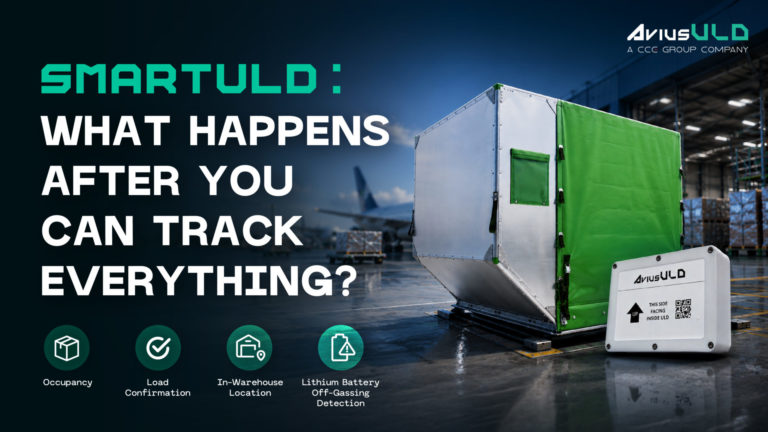
SmartULD combines multiple layers of operational awareness into a single connected platform:
- Continuous global location visibility
- Occupancy sensing to reduce wasted capacity
- Load confirmation to strengthen operational execution
- In-warehouse location visibility to reduce blind spots
- Lithium battery off-gassing detection to identify developing safety risks earlier
Together, these capabilities help airlines reduce wasted capacity, identify issues earlier, improve operational control, and respond faster when problems arise.
If you would like to explore how these capabilities can be applied within your own operations, get in touch with the AviusULD team to discuss use cases, pilot programs, and next steps.