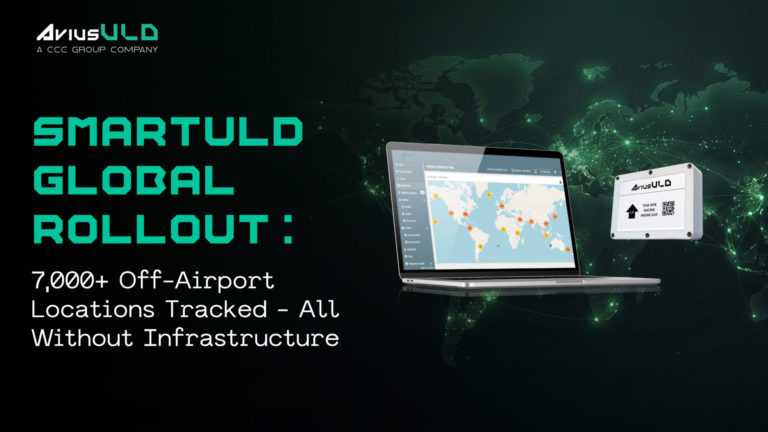
In its first six months of scaled deployment, SmartULD by AviusULD, powered by eloc8, has reached operational scale across the global air cargo network. More than 30,000 SmartULD devices have been delivered, with a further 20,000 SmartULD pallet tags ordered. These devices have reported from 600 airports across 122 countries and, more importantly, have mapped and geofenced over 7,000 off-airport locations. During the same period, more than 100 million operational messages have been processed.
The speed of this rollout is directly linked to the product design. SmartULD devices power themselves through kinetic energy harvesting and communicate over existing global LTE networks. Location is determined using assisted GNSS outdoors and WiFi positioning indoors. No airport readers or fixed hardware installations are required.
In layman’s terms, SmartULD works more like a mobile phone than a traditional tracking tag. It powers itself and connects directly to existing cellular networks, so it doesn’t rely on scanners or reader infrastructure at specific locations. That means it can report its position anywhere there is network coverage, rather than only when it passes a fixed reader. Systems that rely on reader infrastructure provide visibility at checkpoints, but they often lose sight of assets on the apron or when containers move off-airport to forwarders, shippers, and receivers. Because SmartULD generates its own energy through motion and connects directly to the network, it can report continuously across the entire journey.
SmartULD is the only ULD tracking solution that combines self-generated power and direct connectivity with no reliance on readers. All other solutions available rely on expensive legacy infrastructure.
Infrastructure-Free Deployment
Traditional tracking models rely on installed infrastructure at each airport location. Deployment often involves coordination with local authorities, capital expenditure on hardware, and ongoing maintenance of reader networks. Installing equipment inside third-party facilities can also raise questions around insurance and liability, as responsibility must be clearly defined if installed hardware causes damage or disruption.
SmartULD devices operate independently of airport-installed equipment. Each unit contains its own communication capability and energy source. As a result, deployment is tied to the asset rather than the facility. Once a device is mounted to a container or pallet, it begins reporting location and telemetry data through existing network coverage.
This approach allows fleets to be equipped without phased airport rollouts. As routes expand or operations shift, connectivity remains consistent because it is embedded in the asset itself. Devices travel with the container and maintain reporting across hubs, outstations, and off-airport facilities.
Global Visibility Across Airport and Off-Airport Locations
Within six months, SmartULD devices have reported activity from 600 airports across 122 countries and over 7,000 mapped off-airport locations. Off-airport visibility is operationally significant, as containers frequently dwell at freight forwarders, repair stations, and cargo shipper and receiver sites.
Because communication relies on global LTE coverage rather than local readers, reporting continues wherever network access exists. This extends digital visibility across the broader cargo ecosystem, including areas where traditional systems typically have limited reach.
SmartULD also supports automated Stock Control Messages and UCR/LUC messaging through API integration with ULD management systems. Continuous reporting enables stock updates to move from periodic manual entries to event-driven digital data flows.
Operational Data and System Performance
In addition to location, SmartULD devices capture environmental and motion data during live operations. Recorded conditions over the first three months include minimum temperatures of – 46°C (- 50.8°F), humidity levels up to 98 percent, Z-axis acceleration events reaching 998 g, and volatile organic compound readings up to 498 ppm.
These measurements provide insight into how assets and cargo experience real-world conditions. Temperature and humidity data support product assurance for sensitive shipments, Z-axis readings translate into shock and handling events, and VOC monitoring supports early detection of lithium battery off-gassing associated with thermal runaway.
Across the deployed base, the average state of charge of the battery remains approximately 98 percent after six months in service. This reflects the performance of the kinetic energy harvesting system under real operational conditions. The key question was not whether energy harvesting works in principle (it does, much like a self-winding wristwatch), but whether normal ULD movements generate enough energy to sustain the system. The operational data confirms that they do.
Devices are then managed through the AviusConnect platform, which supports over-the-air updates and centralized device management. Firmware enhancements can be deployed remotely without requiring physical access to the asset.
The combination of self-powered hardware, embedded connectivity, and centralized data management enables fleet-scale deployment without airport-based infrastructure investment.
Six months of operational data confirm that global digital visibility can be established rapidly when tracking capability resides within the asset itself.
For further information or to discuss deployment options, contact the AviusULD team to arrange a technical review or demonstration.